Do you people believe in it?
Or do you think its just another media beat up?
Permalink
Permalink
Media Beat up? Over 200 eminent scientists make up the IPCC. Hope you cn find a member of Yellow Fever with the cummulative insights to argue against their evidence!
Permalink
Permalink
Cummulative insight:
Chuck Norris created global warming. He was cold, so he turned the sun up.
But seriously- pretty tough to see something so largely publicised (and proven amongst top scholars) as being media beat up. However, must say that the excessive amount of attention it gets does piss me off a bit, but I guess if it is as serious as it seems then people need to realise the (possible) consequences of it.
Permalink
Permalink
"Global Warming" seems to encompase so many things. Ozone depleteion, melting polar caps, deforestation, pollution, overpopulation, resource depletion. The term global warming seems to come up whenever any of these topics are addressed so it seems to be alsways on the tele.
Permalink
Permalink
Im a "denier" & proud of it !! IF there is a climate change i dont think it's due to man but a natural cycle. How many years of data has the "believers" have? About 50yrs, as opposed to millions of yrs of geological data. And it's a convenient bandwagon for the Greenies to jump on. Carbon footprint, food miles/kilometers...what a load of bollocks!!
Permalink
Permalink
Im a "denier" & proud of it !! IF there is a climate change i dont think it's due to man but a natural cycle. How many years of data has the "believers" have? About 50yrs, as opposed to millions of yrs of geological data. And it's a convenient bandwagon for the Greenies to jump on. Carbon footprint, food miles/kilometers...what a load of bollocks!!
Umm the fact that they can measure any sort of change in 50 years as opposed to the millions of years natural cycle changes take is quite scary. History is rife with examples of human habitation destroying the environment, even before the "industrial" era. the Nile river area was very fertile but, due to over population alone, the area has turned mostly desert, and the river is silting up. this only took about 3000 years to achieve without technology. Im not a greenie, but im not blind, and i sure as hell am not going to say " do nothing because its a natural cycle"
Permalink
Permalink
Im a "denier" & proud of it !! IF there is a climate change i dont think it's due to man but a natural cycle. How many years of data has the "believers" have? About 50yrs, as opposed to millions of yrs of geological data. And it's a convenient bandwagon for the Greenies to jump on. Carbon footprint, food miles/kilometers...what a load of bollocks!!
i think it's much more convenient for many businesses to ignore global warning actually...they have much more at stake in the short run
Cosimo2008-04-07 11:07:15
I like tautologies because I like them.
Permalink
Permalink
As far as i can tell, its all cause and effect. Any action taken has a direct effect on yor surrounding environment - so of course we have caused change.......adverse or otherwise our existance has caused the plant to change. According to the Greenies our habitual over population is killing the planet.
Queenslander 3x a year.
Permalink
Permalink
Its basic maths. resources are finite. at the moment consumption exceeds the planets abilty to restore what we consume. eventually we will burn/evaporate every resource on the planet = game over.
Permalink
Permalink
Sounds like the Chelsea recruitment policy...

Permalink
Permalink
Chelsea probably contribute 40% of global warming
I like tautologies because I like them.
Permalink
Permalink
But we didn't have millennia of humans pumping CFC's into the atmosphere. I certainly think that would have an unnatural impact as opposed to the normal impact.
Given that I got sunburnt playing golf , wearing Factor 15, with cloud at 100ft and drizzle certainly ain't normal in my books.
Given that I got sunburnt playing golf , wearing Factor 15, with cloud at 100ft and drizzle certainly ain't normal in my books.
When Hibs, went up, to win the Scottish Cup - I wisnae there - furfuxake!
Permalink
Permalink
Given that I got sunburnt playing golf , wearing Factor 15, with cloud at 100ft and drizzle certainly ain't normal in my books.
On the other hand, you are Scottish. You'd probably get sunburnt during a six month winter night in the Arctic circle.

Permalink
Permalink
For a Scot, a lighter shade of blue is considered a tan.
Permalink
Permalink
Well I don't buy it. I think its greenies doing what greenies do best, Making the world a worse place for everyone else.
Permalink
Permalink
I just have questions like...
If water expands when it turns to ice (in terms of the amount of space it takes up) then surely the water levels would drop or at the very least stay at the same level they are when the ice melts.
Admittedly there is some ice above the surfice but aren't Ice Bergs 90 % under the water? (and arctic is basically one massive ice berg)
Also the ice shelfs around antartica would be the same.
Please feel free to prove me wrong (as one of you probably will lol)
Pure Genius2008-04-08 15:26:18
Permalink
Permalink
The Arctic is one big Ice Berg. The Antarctic is land.
Permalink
Permalink
The Arctic is one big Ice Berg. The Antarctic is land.
Really?
Oh dammit lol time to use the ole edit key :P
Permalink
Permalink
What I don't get is the massive mistrust of greenies. I can understand concerns over environmentalism slowing progress, but I hardly see any likelihood of a giant conspiracy to force everyone to stop bathing and eat tofu. Almost every environmentalist I know simply advocates responsibility and sustainability, which is common sense, not "the greenie agenda".
The other way to look about it is considering who gains from which argument being considered correct. Global warming a myth? Businesses opposed to it gain billions of dollars. Global warming considered fact? Everyone, greenies involve, gain an increased responsibility to counter the problem.
The other way to look about it is considering who gains from which argument being considered correct. Global warming a myth? Businesses opposed to it gain billions of dollars. Global warming considered fact? Everyone, greenies involve, gain an increased responsibility to counter the problem.
Permalink
Permalink
If water expands when it turns to ice (in terms of the amount of space it takes up) then surely the water levels would drop or at the very least stay at the same level they are when the ice melts.
[/quote]
Ya. But that's if you only count the sea-based ice. All the 'burgs. Think of Fiordland and Scandinavia and various other places like that. Heaps of land-based ice.
[QUOTE=Pure Genius]
Admittedly there is some ice above the surfice but aren't Ice Bergs 90 % under the water? (and artica is basically one massive ice berg)
The majority of them are underwater, yes. But Antarctica is on land. So that's a large chunk of land-based ice.
The Arctic is the floating one.
Personally, I'm kinda undecided. I've heard reports from both sides, but my thinking is that global warming (the act of the globe getting hotter) is more likely to lead to an iceage than a desert...
But I'm a mathematician. What do I know?
Permalink
Permalink
basic physics. water expands when heated. When frozen it also expands due to crystalization.
UberGunner2008-04-08 18:21:02
Permalink
Permalink
i think the term 'global warming' may not be the best one...climate change might be better, but that could mean anything I guess - um, 'pollution change'?
I like tautologies because I like them.
Permalink
Permalink
I think it's real. the data is there and all those people are smarter than me so I'm sticking with them.
Climate change - how good was our summer.. and how sh*t was europe's winter? It's still snowing in Germany and its April! Madness.
As for getting sunburn when its cloudy, thats the sh*t of NZ, i went to Raro last year and didn't wear sunblock on my first day, spent the whole day biking around the island in the sun and didn't get burnt. Was quite a shock for me and my melanin deficient skin.
Permalink
Permalink
But I'm sure on this last point you would want to clarify that higher levels of UV in NZ are for reasons unconnected to global warming 
HarryHotspur2008-04-08 22:44:55
HarryHotspur2008-04-08 22:44:55
Permalink
Permalink
Heres the basics;
The best place to get ancient (paleo) climate data is the ice cores at the poles. Ice freezes differently depending on the variations of chemicals in the atmosphere. Some chemicals have varying concentrations depending on air temperatures.
We can therefore tell what air temperatures and those concentrations must have been like in the past by taking samples of ice that has been frozen at pionts back in time. Looking at the ice samples we get the following information. USE LEFT-RIGHT SCROL BAR to see the full image.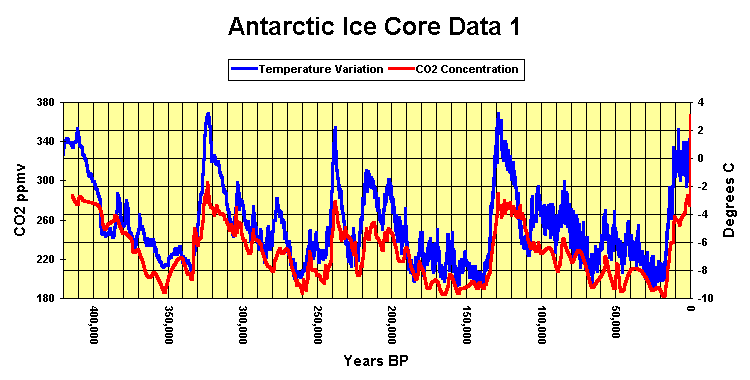 ean
ean
ean Now, note that generally temperatures rise with at approxiamtely the same time as Co2 levels rise in the atmosphere. Ovre time we see a history of up-and-down for both temperature and CO2 concentrations. However the ODD part of this data is the very abrupt peak in the last 500 (actually 100) or so years. This appears to exceed the normal natural cycle, and this is why arguments like
IF there is a climate change i dont think it's due to man but a natural cycle.
are invalid. Becasue yes, there is a natural cycle, but now things are progressing at an unprecendented rate - so can we assume that nature is causing it without human help? UNLIKELY - but still POSSIBLE.
The danger is that there will be some 'lag' before temperatures start to catch up with this rise in CO2, or if they don't rise, they will at least be alteered on a global scale and weather patterns and sea currents will go up the creek.
I give the human cause argument alot of credit, although I also, like Wongo believe that many bodies (corporate, media, NGOs) have jumped on the band wagon becasue the marketing potential is global. Other environmental problems like lack of drinking water and biodiversity loss are not being given enough consideration becasue they tend to be localised, and big organisations get get global marketing leverage from them like they can with "global climate change".

Permalink
Permalink
I'm a believer. Next time you see a scientist on TV or Radio denying it, Google his name. Find out who "research" company he belongs to, who he is funded by, and what qualifications he has. I think you'll find that, while most of them are scientists, they have their degree in a science that is completely unrelated to global warming. Furthermore that they are funded by Mobil or BP etc. (If you don�t believe me watch the documentary called "the denial machine". you should be able to download of the internet somewhere). In summary, most of the scientist denying it aren�t really scientist but quacks and hacks. And yet these small portions of �scientists� get equal time on TV debates.
2ndBest2008-04-09 09:03:42
Permalink
Permalink
unless the bush administration starts preaching about global warming i'm gonna believe in it. frustr8dstriker2008-04-09 12:30:05
Permalink
Permalink
its pretty much undeniable that the earth is heating up, its just the fact that people seem soo scared about it that gets me. i guess i side with the 'its just part of the earth's cycle' group.
Permalink
Permalink
It's the earth's menstral cycle. Hurricanes are PMS.
Cosimo2008-04-09 13:15:29
I like tautologies because I like them.
Permalink
Permalink
<P style="MARGIN: 0cm 0cm 0pt" ="Msonormal"><SPAN lang=EN style="FONT-SIZE: 8.5pt; COLOR: #333333; FONT-FAMILY: Tahoma; mso-ansi-: EN">I'm a believer.� Next time you see a scientist on TV or Radio denying it, Google his name.� Find out who "research" company he belongs to, who he is funded by, and what qualifications he has.� I think you'll find that, while most of them are scientists, they have their degree in a science that is completely unrelated to global warming.� Furthermore that they are funded by Mobil or BP etc. (If you don�t believe me watch the documentary called�"the denial machine". you should be able to download of the internet somewhere).�In summary, most of the scientist denying it aren�t really scientist but quacks and hacks. <SPAN style="mso-spacerun: yes">�</SPAN>And yet these small portions of �scientists� get equal time on TV debates.</SPAN>
I tend to agree with you, but i think that it is important to remember that most significant scientific discovery is based on disestablishing previous 'truth' claims.
While consensus that GW may be due to people (I think the IPCC even qualify this with a 70% probable'assertion')it is the extent to which it may be a problem that is the big unknown. We probably all know the scare tactics employed by people such as Al Gore in his documentary, but the debate about what constitutes 'tipping point' is alive and kicking and very much unresolved.
Oh yes, also check out the blogs of Phillip Stott as they are a great read: he has been unfairly labelled a denier, which is not really the case: but he does question the climate change discourse with alacrity.
http://web.mac.com/sinfonia1/iWeb/Global%20Warming%20Politics/A%20Hot%20Topic%20Blog/A%20Hot%20Topic%20Blog.html
He has long denied links to big business, but I see he recently presented at a Tory conference, which ruffles my feathers somewhat.HarryHotspur2008-04-09 16:37:51
Permalink
Permalink
For all doubters, can we afford to ignore the possibility that it is happening?
http://nz.youtube.com/watch?v=mF_anaVcCXg
And the thing that is scary is that there are many tipping points which could speed up the process and make it impossible to slow down. An example is the Albedo effect, the ability of the surface to reflect heat/light from the sun. As the sea temperature warms and ice melts, there is less ice to reflect heat/light from the sun. The dark water has a low Albedo and can absorb heat from the sun, warms the seas and resulting in more ice loss and so on.
And just to clarify, all floating ice displaces the same amount of water that is stored as ice ie. if you took a glass of water and added an ice block, when that ice block melts the water level wont change. The main concern are glaciers and ice on land that if they melt would result in sea level rises.
Just off the top of my head, if there is just a small change in average temperature, lets say ~1c, you could see huge human migration due to sea level rises, increased disease such as malaria due to warmer weather, desertification of arable land, more extreme weather eg. stronger hurricanes as more warmth in the water increases the energy in hurricanes etc.
Edit - Back on topic: Yes I think that we have had an impact on the Climate. We are reducing the earth's ability to absorb gases such as CO2 by reducing our forests. We are using carbon sinks that have been stored for millennia such as coal and oil and releasing them into the atmosphere. To think that we cannot change the climate we live in is naive.
Bullion2008-04-09 17:04:48
http://nz.youtube.com/watch?v=mF_anaVcCXg
And the thing that is scary is that there are many tipping points which could speed up the process and make it impossible to slow down. An example is the Albedo effect, the ability of the surface to reflect heat/light from the sun. As the sea temperature warms and ice melts, there is less ice to reflect heat/light from the sun. The dark water has a low Albedo and can absorb heat from the sun, warms the seas and resulting in more ice loss and so on.
And just to clarify, all floating ice displaces the same amount of water that is stored as ice ie. if you took a glass of water and added an ice block, when that ice block melts the water level wont change. The main concern are glaciers and ice on land that if they melt would result in sea level rises.
Just off the top of my head, if there is just a small change in average temperature, lets say ~1c, you could see huge human migration due to sea level rises, increased disease such as malaria due to warmer weather, desertification of arable land, more extreme weather eg. stronger hurricanes as more warmth in the water increases the energy in hurricanes etc.
Edit - Back on topic: Yes I think that we have had an impact on the Climate. We are reducing the earth's ability to absorb gases such as CO2 by reducing our forests. We are using carbon sinks that have been stored for millennia such as coal and oil and releasing them into the atmosphere. To think that we cannot change the climate we live in is naive.
Bullion2008-04-09 17:04:48
Permalink
Permalink
There is a new theory out. That although we are contributing, the earth is currently in it's warming up cycle and will one day then head back into an Ice age. We might be helping it speed up, but it is also a natural cycle. Don't ask me who said it, it was on the discovery channel a month or so back.
Proud to have attended the first 175 Consecutive "Home" Wellington Phoenix "A League" Games !!
The Ruf, The Ruf, The Ruf is on Fire!!
The Ruf, The Ruf, The Ruf is on Fire!!
Permalink
Permalink
Maybe a case for nuclear power. We have to consider it. No carbon emissions. Might be a slight problem of getting rid of the waste, but it can be recycled. Greenies say we're not allowed to dam our rivers, mine coal for power stations, wind farms are an eyesore, wave/tidal power facilities will damage the marine enviroment, etc etc. Due to popular belief nuclear plants don't "blow up" like nuclear bombs do. Chernobyl was due to human error, someone did not follow procedures. Boy, I bet I've put a cat in amongst the pigeons.
Permalink
Permalink
Yes it is clearly a natural cycle. But we are also helping to speed that cycle up...No need to panic about it as itll happen eventually anyway? We cant stop it...only try not to contribute to it!
Two views you can take:
1) It wont cause the world to end in my lifetime, so what do i care?
2) I dont want my grandkids children to be affected by this, so lets try control it now for their sakes.
So it depends if you are willing to look and think of people beyond your death...and how far that stretches vs the speed you believe global warming is happening..
I think that made sense. Rant over.
Allegedly
Permalink
Permalink
Maybe a case for nuclear power. We have to consider it. No carbon emissions. Might be a slight problem of getting rid of the waste, but it can be recycled. Greenies say we're not allowed to dam our rivers, mine coal for power stations, wind farms are an eyesore, wave/tidal power facilities will damage the marine enviroment, etc etc. Due to popular belief nuclear plants don't "blow up" like nuclear bombs do. Chernobyl was due to human error, someone did not follow procedures. Boy, I bet I've put a cat in amongst the pigeons.
Chernobyl was absolutely horrendous, though. And most car crashes are due to human error - they happen all the time. The waste can be recycled? i didn't know that
I like tautologies because I like them.
Permalink
Permalink
Maybe a case for nuclear power. We have to consider it. No carbon emissions. Might be a slight problem of getting rid of the waste, but it can be recycled. Greenies say we're not allowed to dam our rivers, mine coal for power stations, wind farms are an eyesore, wave/tidal power facilities will damage the marine enviroment, etc etc. Due to popular belief nuclear plants don't "blow up" like nuclear bombs do. Chernobyl was due to human error, someone did not follow procedures. Boy, I bet I've put a cat in amongst the pigeons.
Thats the problem: NIMBY - not in my back yard. Wind farms are great, but people dont want them and I totally understand why "greenies" are against mining coal. Coal is probably the worst pollutant in terms of non-renewable carbon based fuels, and on top of that they are destroying a habitat.
Personally I am 50/50 on nuclear power, even James Lovelock who proposed Gaia hypothesis, has suggested that this is the way to go. A lesser of two evils if you like. At the moment there are ways or reprocessing some of the waste, though it is very expensive and risky. Also, depleted uranium is used in weapons as it is very hard and can pierce almost any armour. In southern Iraq cancer rates have increased by about 600% since the invasion 5 years ago due to the use of depleted uranium shells.
Personally I would like to see more development on wave/tidal systems, in sunnier climates more use of the sun for energy and in windier ones more wind farms. Hopefully in the near future building design would improve the efficiency of water usage and minimise heating/air conditioning as well having to generate its own power supply for at least heating water and possibly more.
e.g.
http://i.treehugger.com/images/2007/5/24/bahrain_wind_turbine.jpg

http://www.inhabitat.com/2007/11/23/prefab-friday-contruisons-demain-green-prefab/
Permalink
Permalink
And the thing that is scary is that there are many tipping points which could speed up the process and make it impossible to slow down. An example is the Albedo effect, the ability of the surface to reflect heat/light from the sun. As the sea temperature warms and ice melts, there is less ice to reflect heat/light from the sun. The dark water has a low Albedo and can absorb heat from the sun, warms the seas and resulting in more ice loss and so on.
Waste of time taking one factor though - climate change is a result of an incredibly complex system. I was talking to a friend in the MfE who, 3 or 4 years ago experienced 'expert' climate modellers presenting their version of NZs future climate. Apparantly all their assumptions were wrong as their models were based on global patterns, rather than being ammended for the NZ setting. The science is still very contestable - and some of the certainties conveyed by policy makers, in my opinion, belies this.
However, I would still try to reduce my 'footprint' rather than dismiss the essential consensus.
Permalink
Permalink
And the thing that is scary is that there are many tipping points which could speed up the process and make it impossible to slow down. An example is the Albedo effect, the ability of the surface to reflect heat/light from the sun. As the sea temperature warms and ice melts, there is less ice to reflect heat/light from the sun. The dark water has a low Albedo and can absorb heat from the sun, warms the seas and resulting in more ice loss and so on.
Waste of time taking one factor though - climate change is a result of an incredibly complex system. I was talking to a friend in the MfE who, 3 or 4 years ago experienced 'expert' climate modellers presenting their version of NZs future climate. Apparantly all their assumptions were wrong as their models were based on global patterns, rather than being ammended for the NZ setting. The science is still very contestable - and some of the certainties conveyed by policy makers, in my opinion, belies this.
However, I would still try to reduce my 'footprint' rather than dismiss the essential consensus.
Oh yeah, there is a lot going on, just an example.
I think it is more a case of mitigating risk. Not many of us on here are scientists who could argue the finer points of climate science. But we should be discussing the risk involved and steps to take to mitigate that risk.
Permalink
Permalink